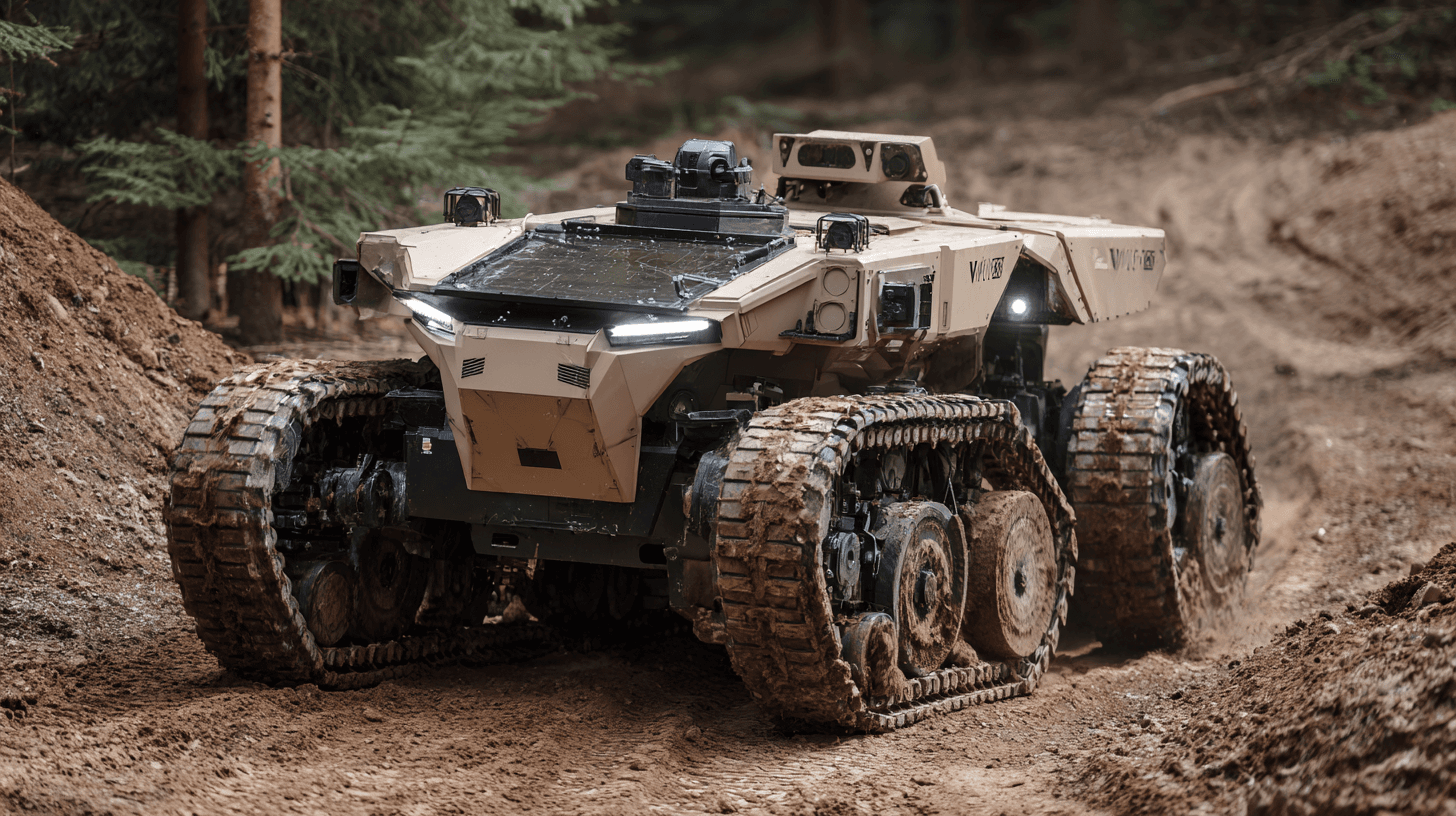
precision_manufacturingUnmanned Ground Vehicles
UGV Drivetrain for Unmanned Ground Vehicle Platforms
Hydrostatic power-split transmission engineered for autonomous and remotely operated platforms. Full-power reversibility, fail-safe limp-home, CAN-bus native — modular Inline or Online output.
hubWhy a power-split drivetrain for UGVs
Built for autonomy, not retrofitted to it
Conventional powershift and pure-hydrostatic transmissions force UGV integrators to choose between efficiency, controllability, and graceful failure. The WSG architecture combines a mechanical and a hydraulic path so the platform retains all three under the loads autonomous duty cycles produce.
Full-Power Reversibility
Hydrostatic power-split delivers identical torque and speed in forward and reverse — no torque loss, no separate reverse gear stage. Critical for autonomous extraction and tight-quarter manoeuvring.
No Blind Hydraulic Loss
Mechanical and hydraulic paths share load continuously. A single hydrostat fault does not strand the platform — torque flow remains observable and controllable through the ECU.
CAN-Bus Controlled
Native CAN integration with the platform autonomy stack. Speed, direction, and torque-limit commands accept single-joystick or fully programmatic control. The architecture is designed for the deterministic loop budgets autonomous duty cycles require.
Fail-Safe Limp-Home Mode
On loss of electronic control, the transmission falls back to a deterministic mechanical mode that allows the vehicle to be recovered under reduced torque rather than immobilised.
Modular Inline / Online Output
Selectable Inline (coaxial) or Online (offset) output stage. Adapts to UGV architectures from compact reconnaissance platforms to heavy logistics mules without redesigning the drivetrain core.
historyEngineering lineage
Three decades of power-split refinement
The hydrostatic power-split architecture used in the WSG drivetrain was developed by the same founding engineers behind earlier-generation power-split transmissions deployed in more than 40,000 off-road and agricultural vehicles. The UGV variant applies that field-validated mechanical core to the additional constraints of unmanned operation: tighter control loops, deterministic failure behaviour, and stricter EMI/integration budgets.
Predecessor designs are attributed to the founding engineers' prior work and not to the OEMs that fielded them.
view_in_arModular output
Inline or Online — same core, two integration paths
Inline output
Coaxial input and output shafts. Shortest packaging envelope — preferred for compact reconnaissance and inspection UGVs where hull volume is the binding constraint.
- · Compact axial length
- · Single mounting plane
- · Lower parasitic drag at cruise
Online output
Offset output shaft for parallel-axis drivetrain layouts. Preferred for heavier logistics and convoy-mule UGVs where axle-line geometry is fixed by the platform.
- · Parallel-axis integration
- · Compatible with existing transfer-case bays
- · Higher continuous torque envelope
Engage engineering
Specifying a UGV drivetrain?
Share your platform envelope and duty cycle. Our engineers respond with a fit assessment and the path to an NDA-gated technical pack.